

From a traditionally discreet profession to a new generation of aviators sharing videos, experiences, and advice on social media. Entertainment, opportunity, or distraction? What matters more: flight hours or followers? Technology continues to advance, but safety, humility, and responsibility remain essential.
By José Zabala, Digital Content Creator
New York.– Social media has become part of virtually every profession, and aviation is no exception. It is increasingly common to find pilots and first officers sharing videos, personal experiences, travel stories, advice, and moments from their everyday lives with thousands of followers.
But an important question deserves attention: Should the public be concerned when they see a video on social media that appears to have been recorded by a pilot inside the cockpit during a commercial flight with passengers on board? Could recording a video for TikTok, Instagram, or Facebook distract someone responsible for operating an aircraft? What happens if a pilot directs attention toward a camera, a phone, or a livestream while performing operational duties? Such concerns are legitimate. However, a video posted on social media does not, by itself, prove that it was recorded during a critical phase of flight or that any regulation was violated. Determining that would require knowing the circumstances of the recording, the responsibilities of each crew member, and the applicable regulations.
Years ago, being a pilot was a profession associated with discretion, prestige, and a certain sense of mystery. It was uncommon to see an aviator posting photographs beside an aircraft, displaying a uniform, or publicly explaining the process of studying to become a pilot. Although there were exceptions, aviation training and professional life generally remained within a more private circle. With the growth of TikTok, Instagram, and other platforms, that reality has become much more visible.
Today, we find pilots running their own social media pages, where they educate the public, answer questions, share experiences, explain aviation-related topics, and offer advice to those who dream of becoming aviators.
This new form of communication can be educational, entertaining, and an opportunity to inspire future generations. However, sharing experiences is not equivalent to serving as a certified flight instructor, nor does it authorize someone to provide professional services that require specific qualifications or ratings.
Modern Times: Modern Pilots, Modern Aircraft, and Modern Technology
Aviation has evolved tremendously. Today’s aircraft feature advanced digital systems, more precise navigation instruments, improved communication tools, and technologies designed to strengthen operational safety.
New generations of pilots are trained in a technological environment very different from that of previous decades. Therefore, it is not surprising that they also use modern tools to communicate with the public.
Technology advances, and professions evolve. What matters is that digital modernization goes hand in hand with preparation, discipline, and aviation safety.
What Matters More: Age, Flight Hours, or Followers?
In aviation, age alone does not determine a pilot’s abilities, nor does popularity on social media.
Flight hours are an important indicator of experience, but the quality of training, certifications and ratings, recent flight experience, demonstrated proficiency, and compliance with safety procedures also matter.
A young pilot may be highly qualified, while a pilot with a longer career may bring valuable accumulated experience. Youth does not necessarily mean a lack of ability, just as seniority alone does not guarantee better performance. Even less does the number of social media followers demonstrate aviation competence.
The Federal Aviation Administration (FAA) establishes age, training, and experience requirements depending on the certificate and duties involved. To obtain an unrestricted Airline Transport Pilot (ATP) certificate, applicants generally must be at least 23 years old and have accumulated 1,500 flight hours, although exceptions and restricted certificates exist.
What Do Aviation Specialists Say About Social Media?
The International Federation of Air Line Pilots’ Associations (IFALPA), in a document published on January 15, 2025, warned about the risks that social media use may pose during flight operations.
The organization noted that devices used for recording can become physical obstructions inside the cockpit and that digital activities can divert attention from flight responsibilities.
It also described incidents in which personal devices used during flight operations interfered with aircraft controls.
This warning is important because it demonstrates that concerns about digital distractions are not merely passengers’ opinions but an issue recognized by professional aviation organizations.
The problem is not sharing experiences or guiding aspiring pilots. Concerns arise when digital exposure creates distractions, unnecessary pressure, reduces rest, or affects personal well-being.
A pilot can be an excellent digital communicator while maintaining a responsible aviation career. Both activities are compatible when clear boundaries are established.
What Does U.S. Aviation Law Allow?
The FAA does not impose a general prohibition preventing pilots from maintaining personal social media pages, posting videos, or sharing experiences during their free time.
However, specific restrictions apply to commercial flight operations.
Federal regulation 14 CFR 121.542 prohibits activities that could distract flight crews during critical phases of flight, including taxiing, takeoff, landing, and certain operations below 10,000 feet, subject to the exceptions established by the regulation.
Additionally, federal law 49 U.S.C. § 44732 restricts the personal use of wireless communication devices and laptop computers by flight crew members at their duty stations in the cockpit during operations governed by Part 121.
Exceptions include uses directly related to flight operations, safety, emergencies, or certain authorized work-related communications, in accordance with approved procedures.
An important clarification: Restrictions on the personal use of these devices are not limited to takeoff and landing. During commercial operations subject to these provisions, restrictions may also apply during cruise flight while crew members occupy their duty stations.
This means that recording personal content while performing flight duties may raise regulatory and safety concerns. Nevertheless, not every recording made aboard an aircraft automatically constitutes a violation.
A video may have been recorded before takeoff, after landing, by another person, or during an authorized activity. Without knowing the circumstances, it would be irresponsible to attribute improper conduct to a particular pilot.
For private aircraft and other types of operations, specific regulations may differ. Applicable safety obligations and procedures established for each type of operation must also be respected.
Airlines may establish policies governing the use of uniforms, corporate image, confidential information, and publications related to their operations, within the applicable legal framework.
Therefore, being both a pilot and a social media influencer is generally permissible in the United States, provided that all applicable legal, professional, and contractual obligations are respected.
Humility and Discretion Are Also Part of Professionalism
There is one quality worth preserving even in this era of digital exposure: a pilot’s humility.
Traditionally, many aviators have preferred to maintain a low profile, avoiding turning their profession into a public spectacle. Such discretion may reflect prudence, although it should not be confused with an obligation to remain anonymous.
Today, appearing on social media does not necessarily mean losing one’s humility. A pilot can share knowledge with simplicity, respect, and responsibility.
However, when the pursuit of recognition overshadows prudence, questions of professional judgment arise. Not everything needs to be published, not every experience must become content, and not every personal opinion represents an airline or the aviation industry.
True professional authority does not depend on how many people recognize a pilot, but rather on preparation, conduct, and the ability to acknowledge the limits of one’s knowledge.
Can Digital Activity Affect a Pilot’s Personal Life?
As in any profession, excessive social media use can take time away from rest, family, and other responsibilities.
For pilots, adequate rest deserves particular attention because of the concentration their work requires. The FAA establishes fatigue-management rules and rest-period requirements for certain commercial operations, including those governed by 14 CFR Part 117.
This does not mean that a pilot who is active on social media is necessarily distracted. The difference lies between using technology as a communication tool and allowing it to become a constant obligation that affects personal well-being.
Pursuing views, comments, and followers can be a recreational activity or even a professional opportunity. The challenge is keeping it within healthy limits without sacrificing rest or personal relationships.
Final Reflection: Aviation Evolves, but Responsibility Never Goes Out of Style!
The presence of pilots and first officers on social media reflects modern times. It can help educate, inspire, and introduce an extraordinary profession to new generations.
There is no reason to criticize those who responsibly share their experiences or to consider a pilot less professional simply for maintaining a social media page.
However, it is also worth remembering that flight hours, preparation, experience, discipline, humility, and respect for regulations carry far more weight than any number of followers.
Aircraft are becoming increasingly modern, technological systems continue to advance, and aviation safety progresses through training, research, and the continuous improvement of procedures.
A modern pilot can maintain a visible social media presence without sacrificing discretion, humility, or respect for the profession.
And the public has the right to expect that when a pilot is operating an aircraft with passengers on board, that pilot’s attention will remain focused on the safety responsibilities of the job.
Because, ultimately, an aviator’s greatest satisfaction should not come from becoming a viral sensation, but from practicing the profession responsibly and helping ensure that every flight reaches its destination safely.
Sources Consulted: Federal Aviation Administration (FAA), 14 CFR §§ 61.153, 61.159, and 121.542, and 14 CFR Part 117; United States Code, 49 U.S.C. § 44732; International Federation of Air Line Pilots’ Associations (IFALPA), Use of Social Media by Pilots, Document 25POS06, dated January 15, 2025.
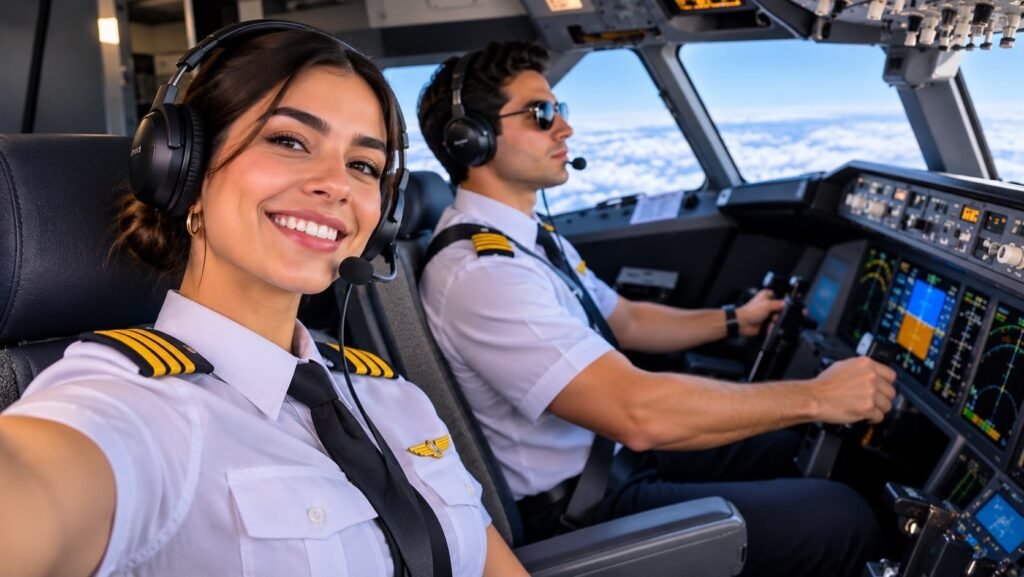
Editorial Note: Observations concerning generational changes, discretion, humility, and public exposure constitute an analysis of professional behavior, not an individual assessment of any pilot or airline. Illustrative image generated using artificial intelligence.
Editorial Clarification: This article is a journalistic reflection on the evolution of aviation and the presence of pilots on social media. It is not intended to question, discredit, or offend any pilot, first officer, institution, or airline. We recognize the right of these professionals to express themselves freely and share their personal experiences, provided they comply with applicable regulations. Our sole purpose is to encourage a respectful discussion about technology, discretion, personal well-being, and professional responsibility.
ZabalaAlDía.com — The Voice Connecting the Dominican Community and Diaspora.
⸻
Editorial and Legal Review Findings
The principal regulatory statements have been cross-checked against FAA regulations, the United States Code, and IFALPA’s official position. These references support the restrictions described concerning distractions and personal electronic devices in the cockpit. Sources: FAA and IFALPA.
The article avoids attributing violations to identifiable individuals and distinguishes hypothetical situations from documented facts. This approach helps reduce defamation risks, but it does not constitute a certification of compliance with every applicable law, nor does it guarantee protection against potential lawsuits.
For greater legal assurance before publication, particularly if the article will be accompanied by actual videos featuring identifiable pilots, a review by an attorney specializing in media and communications law is advisable.
Editorial Recommendation: Publish the article using an AI-generated illustrative image, without photographs, names, logos, or videos of actual pilots that could create the impression that specific individuals are being accused of misconduct. This preserves the public-interest message without directing criticism toward any particular person.
ZabalaAlDía.com — The Voice Connecting the Dominican Community and Diaspora.